

Emerald vs. Diamond Engagement Rings: The Ultimate Guide to Choosing Your Forever Stone

Emerald vs. Diamond Engagement Rings: The Ultimate Guide to Choosing Your Forever Stone
A quiet revolution is happening in bridal jewelry. Today's couples are increasingly trading the default diamond solitaire for something more personal — a stone that carries color, character, and a story that feels entirely their own. And among all the colored gemstones reclaiming their place on engagement ring fingers, emerald stands apart.
Its deep, saturated green has been prized by royalty, artists, and collectors for millennia. Cleopatra famously adorned herself in emeralds. Jackie Kennedy wore an emerald and diamond ring from JFK. The stone carries a visual weight and cultural depth that few gems can rival.
But how does it compare, practically and aesthetically, to the diamond — the stone that has defined engagement ring culture for the better part of a century? By the end of this guide, you'll understand the real differences in durability, cost, maintenance, and meaning — and know exactly which stone fits your life.

The Core Differences: At a Glance
|
Feature |
Emerald |
Diamond |
Notes |
|
Hardness (Mohs Scale) |
7.5 – 8.0 |
10.0 |
Diamond is virtually scratch-proof |
|
Durability |
Good, but vulnerable to hard impact |
Exceptional for daily wear |
Emerald requires mindful wear |
|
Visual Character |
Rich color, warm inner glow |
Maximum brilliance and fire |
Different visual languages entirely |
|
Natural Inclusions |
Common — called "jardin." |
Graded as flaws |
Emeralds' inclusions are celebrated |
|
Cost per Carat |
Generally more affordable |
Significantly higher |
Budget goes further with Emerald |
|
Symbolism |
Growth, renewal, wisdom, love |
Eternal strength, purity |
Both carry deep meaning |
|
Best For |
Distinctive, nature-inspired, vintage aesthetic |
Maximum durability, timeless elegance |
Lifestyle-dependent |
Hardness & Durability
The Mohs hardness scale measures a stone's resistance to scratching. Diamond scores a perfect 10 — nothing in everyday life will scratch it. Emerald scores 7.5 to 8, which is genuinely durable for most daily wear, but with an important caveat: natural emeralds almost always contain internal fractures (part of what makes each stone unique), which means a sharp impact on the edge can cause chipping. The vulnerability is less about scratching and more about impact resistance — something that protective settings can address very effectively.
Sparkle vs. Glow
These two stones pursue completely different visual goals. Diamonds are faceted specifically to maximize light refraction — fire, brilliance, and scintillation in every direction simultaneously. An emerald, particularly one cut in the classic step-cut style, is faceted to showcase its color and transparency. Rather than scattering light into a thousand tiny points, it glows from within — a deep, saturated, almost liquid green that has no parallel in the colorless stone world. One stone speaks in light. The other speaks in color.
The Pros and Cons of Emerald Engagement Rings
Pros
- Distinctive, vintage aesthetic. No two emerald engagement rings look alike, and no emerald ring looks like a diamond ring. The saturated green immediately signals individuality — for the bride who wants a ring that starts a conversation rather than blends into the crowd, emerald is unmatched.
- Appears larger face-up per carat. The classic emerald cut's shallow depth profile pushes more of the stone's weight toward the surface, creating a face-up appearance that exceeds a diamond of the same carat weight. Your budget goes visually further.
- The "jardin" — every stone is one of a kind. Natural emeralds almost universally contain internal inclusions — fine fractures, mineral traces, small feathers of crystal. The French word for these is jardin, meaning "garden." Rather than being treated as defects, a stone's jardin is celebrated as the fingerprint that makes it irreplaceable. No two emeralds have the same garden. For couples who want a ring that is genuinely, permanently unique, this is deeply meaningful.
Cons
- Vulnerable to chipping under hard impact. While an emerald's surface is reasonably scratch-resistant, the internal fractures that create the jardin also create pathways along which a sharp impact can cause chipping. Removing the ring during heavy manual work is more important than with a diamond. The right setting (see below) mitigates this significantly.
- Requires specialized cleaning. Many natural emeralds are treated with cedar oil or resin to enhance their clarity and fill surface-reaching fractures. Ultrasonic cleaners, steam, and harsh chemicals can strip this treatment and damage the stone permanently. Gentle cleaning only — always.
The Pros and Cons of Diamond Engagement Rings
Pros
- Unmatched durability. A diamond can be worn through gardening, gym sessions, dishwashing, and decades of daily life without showing wear. For wearers who don't want to think about their ring — ever — nothing competes with Mohs 10.
- Timeless versatility.A diamond's colorless brilliance pairs with every metal, every outfit, and every decade without ever looking dated.
❌ Cons
- Significantly higher cost per carat. A quality diamond represents a substantial financial commitment that limits options for most buyers. The same budget that buys a modest diamond center stone could purchase a dramatically larger, more visually impressive emerald.
- Less individuality. In a bridal market where diamond solitaires remain the overwhelming majority, choosing one — however beautiful — is a conventional statement. If personal distinction matters, diamonds offer limited visual differentiation.
💡 Worth noting: If you love diamond brilliance but want better value, moissanite offers near-identical sparkle ethically and affordably. Explore our comparison: Moissanite Rings vs. Diamond →
Best Ring Settings to Protect an Emerald
Choosing an emerald doesn't mean accepting vulnerability — it means choosing the right setting. The emerald's exposed edges are its most vulnerable points, and the right architecture around the stone addresses this directly.
Bezel Setting
The bezel wraps a continuous wall of metal around the entire perimeter of the stone, shielding the edges entirely. It's the most protective setting available and gives emerald rings a sleek, sculptural, thoroughly modern aesthetic. For active wearers who love emeralds, a bezel setting is the single best combination of beauty and practical protection.
V-Prongs at the Corners
The four cropped corners of an emerald-cut stone are its most chip-prone points. V-shaped prongs cradle each corner individually, distributing any impact force rather than allowing it to concentrate at the stone's most fragile edges. This is a significantly more protective choice than standard round prongs for rectangular step-cut stones.
Halo Setting
A surrounding halo of smaller diamonds or moissanite stones creates both a visual enhancement and a physical buffer — the accent stones absorb peripheral contact before it reaches the center emerald's edges. As a bonus, the white brilliance of the halo stones amplifies the emerald's green by contrast, making the color appear richer and more saturated.
✨ Build a ring that protects what matters most: Esdomera's Custom Order portal → lets you work directly with the design team to specify exactly the setting style, metal, and protective architecture that suits your stone and your lifestyle. Share images, inspiration links, or simply describe what you're imagining — the team will build it.
Matching Your Love Story: Emerald Couple Sets at Esdomera
Emerald isn't just for her — and Esdomera's couple collections make that philosophy tangible in some genuinely beautiful ways.
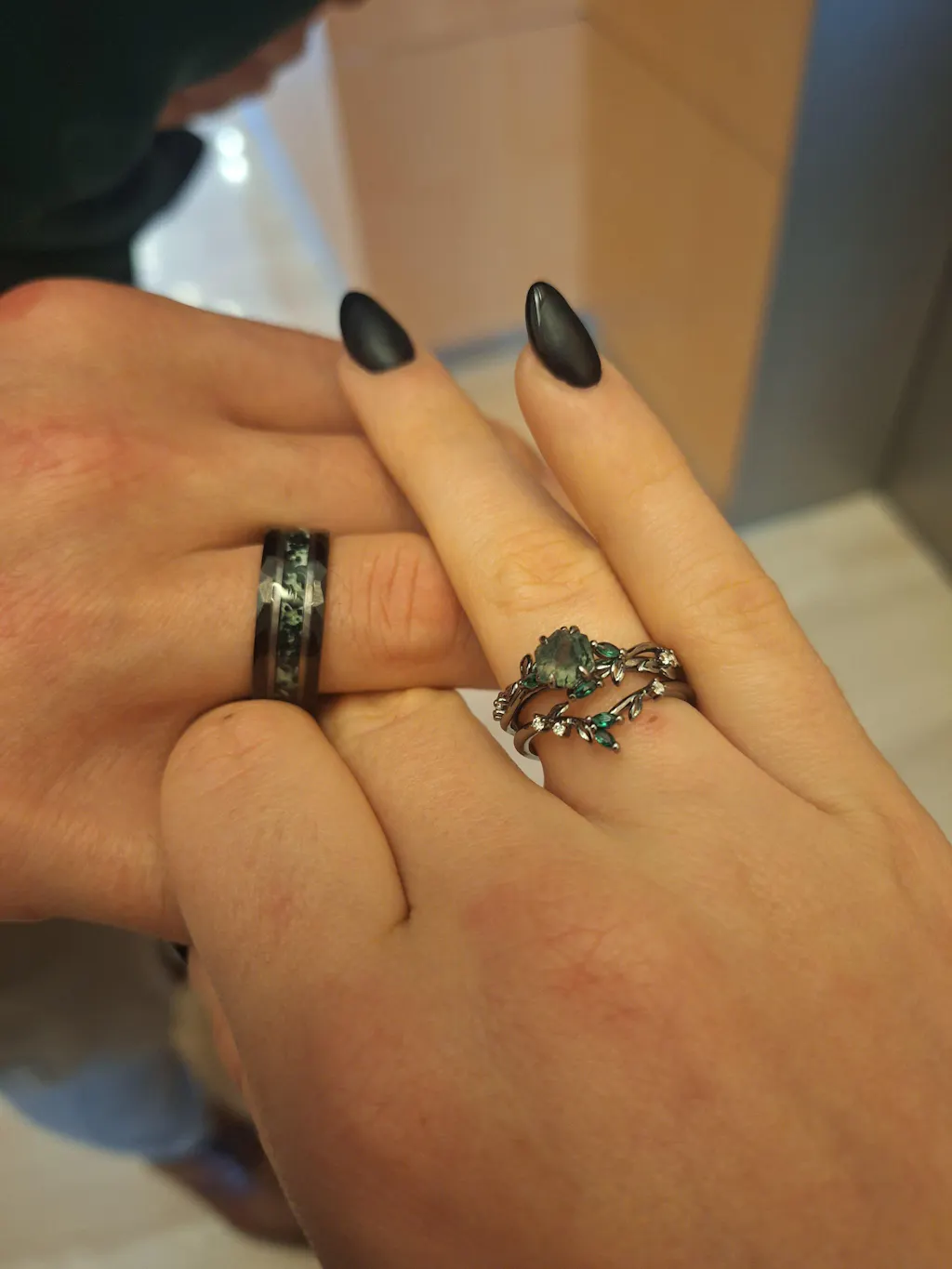
Green Emerald Leaf Design Couple Ring Set
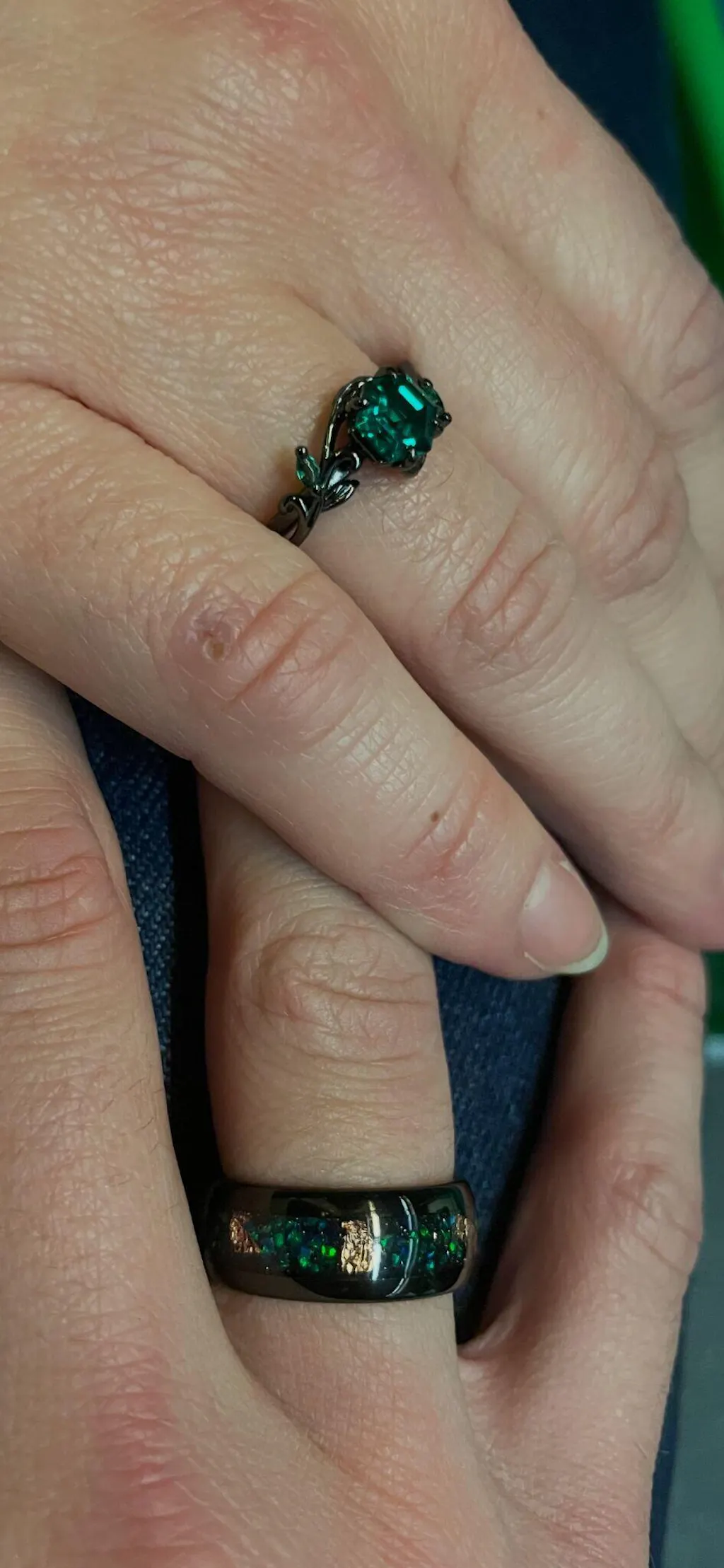
Esdomera's Green Emerald Leaf Design Couple Ring Set is a nature-inspired pairing designed for couples who want their rings to tell a shared story. Her ring features a delicate leaf-motif design with a genuine emerald center stone; his ring is a bold black tungsten band with crushed lab-grown emerald inlay — the green running through both rings like a thread connecting two different expressions of the same idea, earthy, romantic, and entirely unlike anything in the traditional bridal market, available for $230 for the set.
Green Emerald Men's Tungsten Ring (Hammered)
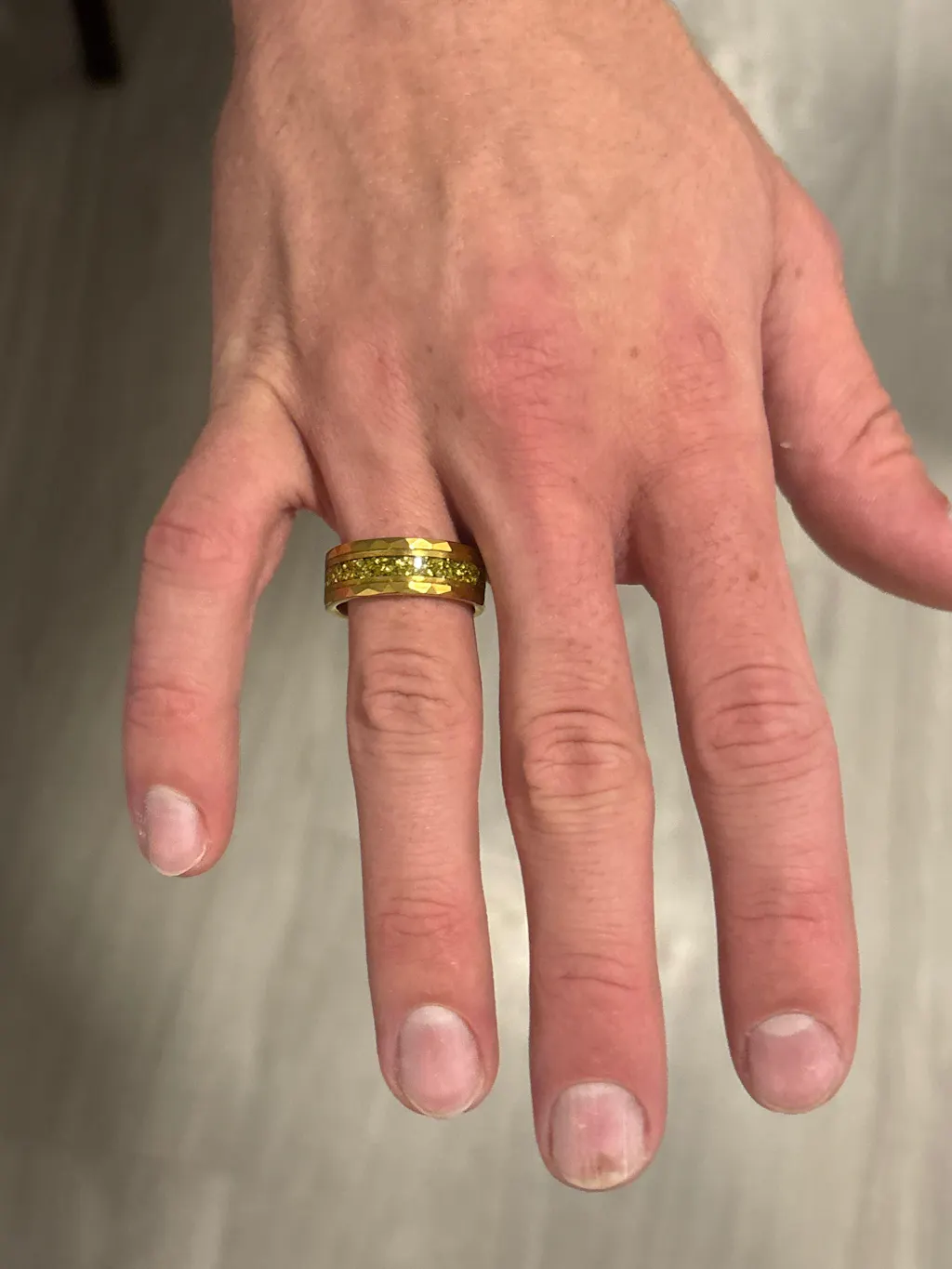
For couples who want coordinated rings without a formal set, Esdomera's Green Emerald Men's Tungsten Ring (Hammered) pairs beautifully alongside any emerald engagement ring. The hammered tungsten band with crushed emerald inlay brings the same green palette into a rugged, architectural men's band — wide, flat-profile, textured, and built to last for decades without maintenance.
🛒 Shop Esdomera's Emerald Collections
|
What You're Looking For |
Shop Here |
|
💚 Emerald engagement rings |
|
|
🌿 Emerald green rings |
|
|
💑 Emerald couple ring sets |
|
|
👨 Men's emerald tungsten band |
|
|
✏️ Custom emerald ring design |
The Best of Both Worlds: Pairing Emeralds with Moissanite or Lab Diamonds
One of the most compelling design moves in contemporary engagement rings is the emerald center stone paired with moissanite or lab-grown diamond accents — and the logic is compelling on every level.
Emeralds, as discussed, produce color and glow rather than fire and brilliance. Moissanite and lab-grown diamonds produce exactly that fire — and when set around an emerald center stone as a halo, side stones, or pave band, the contrast between the emerald's deep green and the surrounding white brilliance creates a visual dynamic that neither stone achieves alone.
The practical advantages compound this: moissanite and lab-grown diamonds are ethically sourced, environmentally responsible, and dramatically more affordable per carat than mined diamonds — meaning the budget saved on accent stones can be redirected toward a larger, higher-quality emerald center stone. The ring benefits from this trade-off on every dimension simultaneously.
Esdomera's Emerald Engagement Rings → collection features several designs built precisely on this principle, and the Custom Order → service can build any combination of emerald center and moissanite accents to your exact specifications.
Frequently Asked Questions
Can I wear an emerald engagement ring every day?
Yes — with mindful habits. Emerald is durable enough for normal daily wear: desk work, socializing, cooking, and light activity are all fine. The key is removing your ring before heavy manual labor, gym sessions, gardening, and washing dishes — activities that combine impact risk with chemical exposure. Build that one habit, and your emerald ring will look beautiful for a lifetime.
Which is more expensive — an emerald or a diamond?
For most buyers, emerald is significantly more affordable per carat. Commercial-grade natural emeralds of good color and acceptable clarity cost a fraction of equivalent-sized diamonds, allowing buyers to choose a larger, more visually striking center stone within the same budget. The price landscape does have nuance at the top end — museum-quality Colombian emeralds with exceptional color saturation and no visible jardin can rival or exceed diamond prices per carat — but these are collector stones outside the typical engagement ring market. For the vast majority of buyers, emeralds offer an extraordinary visual presence at a price point that diamonds cannot match.
How do I clean my emerald ring?
Mild soap, warm water, and a soft brush — nothing else. Many natural emeralds are treated with cedar oil or resin to enhance their appearance, and harsh chemicals, ultrasonic cleaners, and steam can permanently damage this treatment and the stone itself. A gentle clean with a soft toothbrush, rinsed thoroughly and patted dry, every week or two keeps your emerald looking its best without any risk.
What is "jardin" and should I avoid it?
No — embrace it. The jardin (French for "garden") refers to the natural inclusions — fine fractures, mineral traces, and internal clouds — found in almost every natural emerald. Unlike diamonds, where inclusions are graded as quality defects, an emerald's jardin is understood as a natural feature of the stone. A completely inclusion-free natural emerald is actually extremely rare and commands a significant premium. For most buyers, a stone with moderate, attractive jardin is the norm — and the right frame for thinking about it is uniqueness, not imperfection. Your ring's jardin is shared by no other stone in the world.
Is an emerald cut and an emerald gemstone the same thing?
No, they are completely different things that share a name. An emerald cut is a rectangular step-cut faceting style originally developed for cutting emerald gemstones to reduce pressure during the process — but it is now applied to diamonds, moissanite, and almost every other gemstone. An emerald is the green gemstone from the beryl mineral family. You can have an emerald-cut diamond, a round emerald gemstone, or — beautifully — an emerald-cut emerald. For a deep dive into the emerald cut as a diamond shape, see our guide: Radiant Cut vs. Emerald Cut Diamond Rings →
The Final Verdict
|
Your Priority |
Your Stone |
|
Maximum everyday durability, zero worry |
💎 Diamond |
|
Distinctive color, personal character |
💚 Emerald |
|
A ring that is genuinely one of a kind |
💚 Emerald (jardin makes it so) |
|
Timeless, versatile elegance |
💎 Diamond |
|
Larger visual presence on a budget |
💚 Emerald |
|
Nature-inspired, vintage aesthetic |
💚 Emerald |
|
Matching couple sets with shared color story |
💚 Emerald |
An emerald engagement ring asks a little more of you — more care, more mindful wearing, more deliberate cleaning. In return, it gives you something no diamond can: a stone that glows with ancient color, carries a garden of inclusions that belongs to no other ring in the world, and announces from across the room that the person wearing it made an entirely intentional choice.
Ready to find yours?
Leave a comment