

Morganite Ring Guide

Morganite has captivated jewelry lovers worldwide as a uniquely romantic alternative to traditional diamond engagement rings. This peachy-pink gemstone from the prestigious beryl family (which includes emerald and aquamarine) offers a captivating blend of soft color, brilliant sparkle, and exceptional affordability. This definitive guide covers everything from quality factors and pricing to long-term care strategies, helping you make a confident, informed decision about whether morganite is the right choice for your ring.
What Is Morganite? The Story Behind the Stone
Morganite is a pink to peachy-pink variety of beryl (the same mineral family as emerald and aquamarine), colored by manganese, discovered in 1910 and named after financier J.P. Morgan.
A Gem of Romance: History and Symbolism
Discovery (1910, Madagascar): Morganite was first identified as a distinct beryl variety by gemologist George Frederick Kunz, who was chief gemologist for Tiffany & Co. He named it after his patron and prominent gem collector John Pierpont Morgan (J.P. Morgan), the influential American banker and financier.
Early popularity: The New York Academy of Sciences officially accepted the name "morganite" in 1911. Tiffany & Co. was instrumental in promoting the gem during the early 20th century, establishing it as a gemstone of elegance and sophistication.
Primary sources today:
- Brazil: Minas Gerais region (largest commercial source, fine peachy-pink colors)
- Madagascar: High-quality crystals, often with deeper saturation
- Afghanistan: Produces some of the finest, most intensely colored specimens
- United States: California, Maine (historical significance, smaller production)
- Mozambique, Namibia, Pakistan: Secondary sources
Modern symbolism:
- Divine love: Associated with unconditional love, compassion, and emotional healing
- Promise & commitment: Popular for engagement rings symbolizing lasting devotion
- Compassion & tenderness: Believed to open the heart chakra to give and receive love
- New beginnings: Connected to fresh starts and romantic new chapters
- Inner strength: Thought to provide emotional resilience during challenges
Cultural significance: While morganite lacks ancient cultural history (discovered only ~115 years ago), it has rapidly become associated with modern romance, particularly appealing to brides seeking alternatives to traditional diamonds.
Understanding Morganite's Signature Color
Color range: Morganite occurs in a spectrum from pale blush pink to vibrant peachy-pink to salmon-orange.
Color chemistry:
- Manganese (Mn²⁺): This trace element creates morganite's signature pink color
- Iron content: Additional iron can shift color toward peachy or orange tones
- Color intensity: Depends on manganese concentration—higher levels produce deeper saturation
Color grading scale:
-
Exceptional (Most Valuable): Deep peachy-pink to salmon with strong saturation; medium to medium-dark tone
- Origin: Often Afghanistan, premium Brazilian material
- Characteristics: Visible color even in smaller sizes (under 2ct)
- Price premium:3-5x standard grades
-
Fine/Premium: Medium peachy-pink with good saturation; medium tone
- Origin: Brazil, Madagascar
- Characteristics: Attractive color requires ~1.5-2ct+ to show well
- Value: Best balance of beauty and affordability
-
Commercial/Good: Pale pink to very light peachy-pink
- Origin: Various
- Characteristics: Subtle color; requires 3ct+ for visible impact
- Discount:40-60% below premium grades
Heat treatment (industry standard):
- Purpose: Most morganite undergoes low-temperature heat treatment (400-450°C) to reduce yellow/orange tones and enhance pure pink
- Stability: Permanent and irreversible—color will not fade or revert
- Detection: Virtually undetectable; considered standard practice
- Disclosure: Reputable sellers should disclose treatment, though it's assumed for commercial morganite
Natural vs. heated: Untreated morganite often shows peachy or salmon tones. Pure pink typically indicates heat treatment, which is accepted and stable.

Is a Morganite Ring Right for You? A Practical Look at Pros and Cons
Morganite offers stunning color and affordability but requires more maintenance than diamonds and is softer (7.5-8 Mohs); ideal for careful daily wear, less suitable for extremely active lifestyles.
Morganite vs. Diamond: Key Differences
|
Feature |
Morganite |
Diamond |
|
Hardness (Mohs) |
7.5-8 |
10 |
|
Refractive Index |
1.577-1.583 |
2.417-2.419 |
|
Sparkle Type |
Vitreous (glassy) |
Adamantine (diamond-like) |
|
Price (1ct, good quality) |
300−300−500 |
4,000−4,000−12,000 |
|
Maintenance |
Weekly cleaning needed |
Monthly cleaning sufficient |
|
Durability |
Good (careful wear) |
Excellent (all conditions) |

Best for:
- Those prioritizing unique color over maximum durability
- Budget-conscious couples seeking large center stones
- Brides with fair-medium skin tones (peachy-pink is flattering)
- Careful wearers who remove jewelry during activities
- Those drawn to romantic, feminine aesthetics
Not ideal for:
- Extremely active lifestyles (rock climbing, CrossFit, manual labor)
- Those wanting the lowest-maintenance option
- Dark skin tones, where pale pink may not show well
- Maximum durability priority (choose sapphire instead)
Browse options: buy Morganite rings
The 4Cs of Morganite: How to Choose a High-Quality Gem
Prioritize color saturation (deeper peachy-pink is best), eye-clean clarity, excellent cut for maximum sparkle, and larger carat sizes (1.5ct+) to showcase color.
Color: The Most Important Factor
Color accounts for 50-60% of morganite's value. Unlike diamonds, where cut dominates, morganite's appeal centers on its romantic hue.
What to look for:
Hue:
- Best: Pure pink to peachy-pink (slight orange undertone acceptable)
- Good: Light peachy-pink
- Avoid: Brown, gray, or muddy secondary colors
Saturation:
- Best: Vivid to strong saturation—color visible from a distance
- Good: Moderate saturation—pleasant but softer
- Avoid: Weak saturation—appears nearly colorless
Tone:
- Best: Medium to medium-light (not too pale, not too dark)
- Balance: Light enough for brilliance but saturated enough for visible color
Color distribution:
- Look for even color throughout the stone
- Avoid visible color zoning (bands of different intensity)
Size impact on color: Morganite's pale color requires adequate size to be visible:
- Under 1 carat: May appear nearly colorless
- 1-1.5 carats: Subtle color visible
- 5-3 carats: Sweet spot—color visible, affordable
- 3+ carats: Strong color presence, dramatic impact
Clarity: An "Eye-Clean" Standard
GIA Type 1 Classification: Morganite naturally forms with very few inclusions, placing it in the cleanest gemstone category (along with aquamarine, blue topaz, and tanzanite).
Clarity expectations:
- Standard: Eye-clean (no visible inclusions to the naked eye)
- Acceptable: Minute inclusions visible only under 10x magnification
- Avoid: Eye-visible inclusions, clouds, or internal fractures
Common inclusions (when present):
- Liquid inclusions (healed fractures filled with fluid)
- "Rain" inclusions (parallel tube-like inclusions)
- Crystal inclusions (tiny minerals trapped during formation)
Why clarity matters: Unlike colored stones, where some inclusions are tolerated, morganite should always be eye-clean due to its naturally high clarity. Visible inclusions reduce value significantly.
Cut: Unlocking Sparkle and Brilliance
A well-executed cut is crucial to maximize morganite's sparkle and prevent the "washed out" appearance that plagues poorly cut stones.
Cut quality indicators:
Proportions:
- Depth:60-70% of diameter (too shallow = less sparkle; too deep = dark appearance)
- Table:53-65% of diameter (optimal light return)
- Symmetry: Even facet alignment for uniform sparkle
Polish:
- High polish is essential for maximum brilliance
- Look for mirror-smooth facets without visible scratches
Shape considerations:
Oval (Most Popular):
- Advantages: Elongates the finger, maximizes the carat weight appearance, and provides excellent sparkle
- Ideal ratio:3:1 to 1.5:1 (length to width)
- Best for: Engagement rings, showing off color
Cushion (Romantic Choice):
- Advantages: Soft corners, vintage appeal, larger face-up size
- Ideal ratio:0:1 (square) to 1.15:1 (slightly rectangular)
- Best for: Vintage/romantic styles, halo settings
Round (Classic Brilliance):
- Advantages: Maximum sparkle, timeless, universally flattering
- Trade-off: Loses more rough (higher cost per carat)
- Best for: Solitaires, traditional designs
Emerald/Asscher (Step Cut):
- Advantages: Hall-of-mirrors effect, showcases color purity, Art Deco appeal
- Requirements: Requires excellent clarity (step cuts show inclusions)
- Best for: Minimalists, those prioritizing color over sparkle
Pear, Marquise, Radiant: Less common but available; choose based on personal preference

Carat Weight: Affordable Size
Morganite's pricing is nearly linear—unlike diamonds, where price increases exponentially with size, morganite costs scale gradually.
Size recommendations by ring type:
|
Ring Type |
Recommended Size |
Why |
|
Engagement Ring |
1.5-3 carats |
Color visible, proportionate to hand, affordable |
|
Fashion/Cocktail |
3-8 carats |
Statement piece, dramatic color |
|
Stacking Ring |
0.5-1 carat |
Subtle accent complements other rings |
|
Three-Stone |
1-2ct center, 0.5ct sides |
Balanced proportions |
Price impact example (per carat, fine quality):
- 1 carat: 300−400/ct=300−400/ct=300-400 total
- 2 carats: 350−450/ct=350−450/ct=700-900 total
- 3 carats: 400−500/ct=400−500/ct=1,200-1,500 total
The "bigger is better" consideration: For morganite specifically, larger sizes (2-3ct+) are often recommended because:
- Color shows better in larger stones
- Price increase is minimal
- Proportions look more balanced in settings
Explore styles: shop Morganite Engagement Rings
The Definitive Price Guide: How Much Should a Morganite Ring Cost?
Quality morganite costs 250−250−500 per carat for loose stones; complete rings range from 800−800−3,500 depending on metal, setting complexity, and accent stones.
Morganite Price Per Carat (2025 Market Rates)
Loose stone pricing by quality:
|
Quality Grade |
Color Description |
Price Per Carat |
Total (2ct stone) |
|
Exceptional |
Deep peachy-pink, vivid saturation |
450−450−700 |
900−900−1,400 |
|
Premium/Fine |
Medium peachy-pink, good saturation |
300−300−450 |
600−600−900 |
|
Commercial/Good |
Light pink to pale peachy |
150−150−300 |
300−300−600 |
|
Lower Grade |
Very pale, poor cut, inclusions |
50−50−150 |
100−100−300 |
Size impact (fine quality):
- 1 carat: $300-400/ct
- 2 carats: $350-450/ct
- 3 carats: $400-500/ct
- 5 carats: $450-600/ct
- 10+ carats: $500-700/ct
Factors increasing price:
- Deeper saturation (peachy-pink vs. pale pink)
- Afghan or premium Brazilian origin
- Larger sizes with maintained color
- Exceptional cut quality
- Untreated natural color (rare, significant premium)
Setting the Price: How Metal Choice Affects Total Ring Cost
Complete ring pricing examples (using 2ct fine morganite, $700 stone cost):
14k Rose Gold Solitaire:
- Stone:2ct morganite = $700
- Setting:Simple 4-prong solitaire = $400-600
- Total:$1,100-1,300
- Best for: Budget-conscious, minimalist style
14k White Gold with Diamond Halo:
- Stone:2ct morganite = $700
- Setting:Halo setting = $600-900
- Diamonds:30ctw halo = $300-500
- Total:$1,600-2,100
- Best for: Maximum sparkle, vintage appeal
14k Yellow Gold Three-Stone:
- Center stone:2ct morganite = $700
- Side stones:2x 0.5ct morganite = $300
- Setting:Three-stone mounting = $500-700
- Total:$1,500-1,700
- Best for: Balanced design, vintage warmth
Platinum Pavé Band:
- Stone:2ct morganite = $700
- Setting:Platinum pavé setting = $1,200-1,800
- Diamonds:50ctw pavé = $500-800
- Total:$2,400-3,300
- Best for: Luxury, maximum durability
18k Rose Gold Art Deco Design:
- Stone:2ct morganite = $700
- Setting:Custom Art Deco mounting = $1,000-1,500
- Diamonds:Geometric accents = $400-700
- Total:$2,100-2,900
- Best for: Unique design, heirloom quality
Budget-friendly options: See Our Morganite Rings Under $2,000
Morganite vs. Other Pink Gemstones: A Head-to-Head Comparison
Answer-first: Morganite offers the best balance of affordability and size for pink gemstones; pink sapphire provides superior durability; pink diamonds offer ultimate sparkle but at 50-100x the cost.
Detailed Comparison Table
|
Gemstone |
Mohs Hardness |
Sparkle (RI) |
Avg. Cost/Carat |
Color |
Key Takeaway |
|
Morganite |
7.5-8 |
1.577-1.583 (Good) |
250−250−500 |
Peachy-pink to pink |
Beautiful, affordable choice; requires care |
|
Pink Sapphire |
9 |
1.762-1.770 (Excellent) |
800−800−3,000+ |
Hot pink to pastel |
Ultra-durable, vibrant classic; pricier |
|
Lab Pink Diamond |
10 |
2.417-2.419 (Exceptional) |
1,500−1,500−4,000 |
Pale to intense pink |
Ultimate sparkle/hardness; the lab makes it accessible |
|
Natural Pink Diamond |
10 |
2.417-2.419 (Exceptional) |
20,000−20,000−100,000+ |
Rare, all intensities |
Investment-grade luxury; extremely rare |
|
Pink Tourmaline |
7-7.5 |
1.624-1.644 (Good) |
200−200−600 |
Vibrant pink-red |
Vibrant but softer; similar care to morganite |
|
Pink Topaz |
8 |
1.619-1.627 (Good) |
50−50−150 |
Pale pink |
Affordable but less valuable; often treated |
|
Rose Quartz |
7 |
1.544-1.553 (Moderate) |
10−10−50 |
Milky pink |
Budget option: cloudy appearance, low value |
Detailed Comparisons
Morganite vs. Pink Sapphire:
Choose Morganite if:
- Budget is the primary concern (300/ctvs 300/ctvs 2,000/ct)
- You want larger stones (3-5ct affordable)
- Soft peachy-pink appeals more than hot pink
- You'll be mindful of jewelry care
Choose Pink Sapphire if:
- Maximum durability is essential (Mohs 9)
- An active lifestyle requires the toughest stone
- Vivid, saturated pink is preferred
- Long-term value retention matters
- Willing to accept smaller sizes within the budget
Morganite vs. Lab-Grown Pink Diamond:
Choose Morganite if:
- Peachy tones appeal more than pure pink
- Budget under $2,000 for a complete ring
- Larger sizes (2-3ct) desired
- Comfortable with "colored gemstone" category
Choose Lab Pink Diamond if:
- Maximum sparkle is priority (RI 2.42 vs. 1.58)
- Hardness 10 provides peace of mind
- "Diamond" designation matters emotionally
- Budget allows $1,500-4,000/ct
Morganite vs. Pink Tourmaline:
Choose Morganite if:
- Softer pastel tones preferred
- Better clarity is important (Type 1 vs. Type 2)
- Slightly better durability desired (8 vs. 7-7.5)
- More traditional engagement stone appeal
Choose Pink Tourmaline if:
- Vibrant, saturated color is a priority
- Untreated stones are important (less treatment than morganite)
- Budget similar ($200-600/ct)
- Unique, less common gemstone appeals

For women's styles: buy morganite rings for women
Designing Your Perfect Morganite Ring: Settings, Metals, and Style
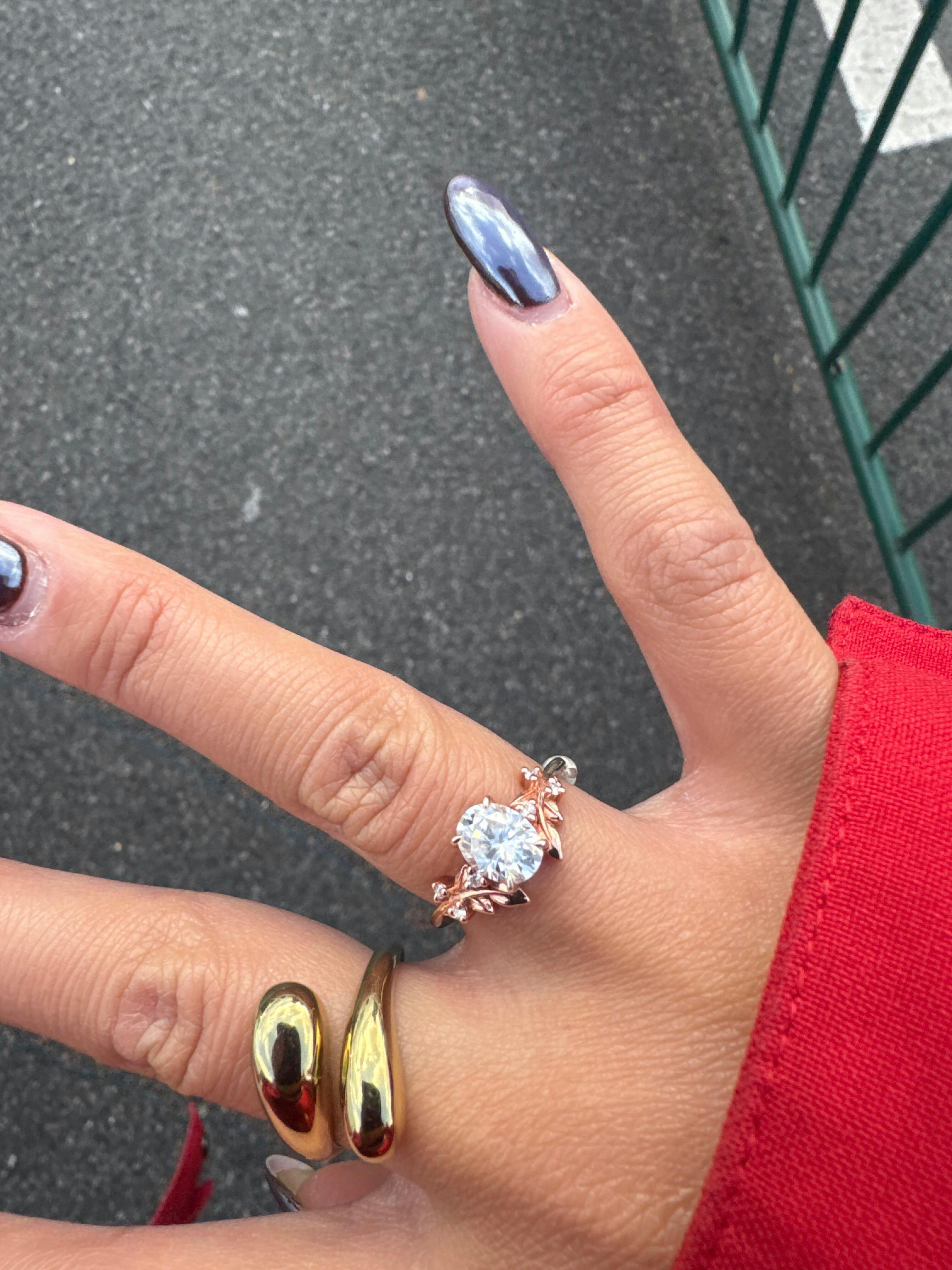
Rose gold best enhances morganite's pink tones (most popular); white gold/platinum creates high-contrast drama; protective halo or bezel settings recommended for durability.
The Best Metal for Morganite: Rose Gold, Yellow Gold, or Platinum?
Metal choice profoundly affects how morganite's color is perceived and the overall aesthetic.
Rose Gold (14k-18k) — MOST POPULAR:
- Visual effect: Amplifies and enhances peachy-pink tones; creates seamless, romantic harmony
- Color interaction: Warm rose metal + peachy stone = cohesive, feminine elegance
- Style associations: Modern romantic, vintage revival, feminine
- Skin tone compatibility: Best on fair to medium skin tones
- Popularity:~60-70% of morganite engagement rings choose rose gold
- Price:Moderate (14k: 40−50/gram;18k:40−50/gram;18k:55-70/gram)
White Gold (14k-18k) / Platinum:
- Visual effect: Creates dramatic contrast; makes pink appear more vibrant and saturated
- Color interaction: Cool metal vs. warm stone = eye-catching juxtaposition
- Style associations: Modern, classic elegance, Art Deco
- Best for: Those wanting morganite to "pop"; pairing with diamonds
- Consideration: Can make very pale morganite look washed out
- Price:White gold moderate; platinum premium (2-3x gold cost)
Yellow Gold (14k-18k):
- Visual effect: Adds warmth; can make peachy tones appear more orange
- Color interaction: Warm-on-warm creates a vintage, antique feel
- Style associations: Vintage, traditional, Edwardian revival
- Best for: Vintage lovers, warm-toned aesthetics, heirloom appeal
- Consideration: Less popular for morganite (shows less contrast)
- Price: Moderate (similar to rose gold)

Expert recommendation: For most morganite, rose gold is optimal—it creates the cohesive "pink-on-pink" aesthetic that maximizes the stone's romantic appeal.
Popular Setting Styles That Protect and Enhance
Halo Settings (Most Popular for Morganite):
- Design: Center morganite surrounded by a diamond or moissanite halo
-
Advantages:
- Adds sparkle and visual contrast
- Protects stone edges from impacts
- Makes the center stone appear 0.5-1ct larger
- Classic yet trendy aesthetic
- Best for: Maximizing impact on budget, engagement rings
- Price add:$400-1,200 (depending on diamond quality/quantity)
Bezel Settings (Maximum Protection):
- Design: The Metal rim completely surrounds the stone
-
Advantages:
- Maximum edge protection (no exposed corners)
- Modern, sleek aesthetic
- Low profile reduces snag risk
- Showcases morganite's solid color field
- Best for: Active lifestyles, modern aesthetics
- Consideration: Slightly reduces light entering the stone
- Price: Moderate ($400-800 for quality bezel)
Solitaire with 6 Prongs (Classic & Secure):
- Design: Single morganite held by 6 prongs (vs. traditional 4)
-
Advantages:
- Timeless, elegant simplicity
- Maximum light entry for sparkle
- 6 prongs are more secure than 4 for softer stones
- Showcases stone without distraction
- Best for: Traditional elegance, letting stone be the star
- Maintenance: Check prongs every 6-12 months
- Price: Most affordable ($300-600)
Three-Stone Settings (Symbolic Choice):
- Design: Center morganite flanked by two accent stones
- Symbolism: Past, present, future
-
Options:
- All morganite (tonal harmony)
- Morganite + diamonds (sparkle contrast)
- Morganite + other beryls (aquamarine, etc.)
- Best for: Meaningful symbolism, balanced composition
- Price: Moderate ($600-1,200 depending on side stones)
Vintage/Art Deco Inspired:
- Design: Geometric patterns, milgrain details, filigree, step-cut morganite
- Advantages: Unique, intricate craftsmanship, period authenticity
- Best cuts: Emerald, Asscher (complement Art Deco geometry)
- Best for: Vintage lovers, collectors, unique statement pieces
- Price:Premium ($1,000-2,500+ for quality vintage reproductions)
The Perfect Match: Wedding Bands That Complement Morganite
Diamond Pavé Bands:
- Style: Continuous small diamonds around the band
- Effect: Adds sparkle without competing with the center stone
- Metal: Rose gold most popular; white gold for contrast
- Price:$500-1,500
Curved/Contoured Bands:
- Style: Band curves to nestle against the engagement ring
- Effect: Creates seamless, unified look
- Best for: Halos, three-stones, any raised settings
- Price:$400-1,000
Vintage Milgrain Bands:
- Style: Beaded edging, engraving, vintage details
- Effect: Echoes Art Deco/Edwardian aesthetics
- Best for: Vintage-inspired engagement rings
- Price:$350-900
Plain Metal Bands:
- Style: Simple, polished rose/yellow/white gold
- Effect: Classic, let the engagement ring be the star
- Best for: Those preferring simplicity, budget-conscious
- Price:$250-600
Stackable Bands:
- Style: Multiple thin bands (can include morganite, diamonds, or mixed gems)
- Effect: Customizable, trendy, can build over time
- Best for: Modern aesthetics, personalization lovers
- Price:$200-500 per band
Couple of options: buy Morganite couple Rings
Frequently Asked Questions (FAQ)
Is Morganite a real gemstone?
Yes. Morganite is a genuine natural gemstone and a recognized variety of the mineral beryl (the same family as emerald and aquamarine). It forms naturally in pegmatite deposits and is colored by manganese. While most morganite undergoes heat treatment to enhance pink color (removing yellow tones), it is a 100% natural mineral material, not synthetic or simulated. Discovered in 1910 and named after J.P. Morgan, it has over a century of gemological recognition.
Does Morganite fade over time?
No, properly treated morganite is color-stable and will not fade with normal wear. The heat treatment that most morganite undergoes (low-temperature heating to remove yellow tones) is permanent and irreversible—the color will not revert or fade from sunlight, age, or normal exposure. However, (1) Prolonged extreme heat (above 400°C, not achievable in normal wear) could theoretically affect color, (2) Accumulation of oils/dirt can make it appear duller (solved by cleaning). Bottom line: With normal care, your morganite will maintain its color for generations.
Can I wear my morganite ring every day?
Yes, with mindful care. At 7.5-8 Mohs hardness, morganite is durable enough for daily wear—harder than glass, most metals, and many gemstones. However, it's softer than sapphire (9) and diamond (10), meaning: (1) It can be scratched by quartz, sand, and harder gems, (2) It can chip if struck sharply on edges. Best practices for daily wear: Choose protective settings (halo, bezel, 6-prong), remove during high-risk activities (exercise, cleaning, manual work), and clean weekly to maintain sparkle. Many people successfully wear morganite engagement rings daily for years with these precautions.
Why does my morganite ring look cloudy?
Most commonly: oil and lotion buildup. Morganite's surface chemistry causes it to attract and hold body oils, cosmetics, soaps, and lotions more readily than many gemstones. This creates a film that makes the stone appear dull, lifeless, or cloudy—even though the stone itself is fine. Solution: Clean your ring weekly with mild soap, lukewarm water, and a soft brush, paying special attention to behind the stone where oils accumulate. If cleaning doesn't restore clarity: (1) The stone may have been included from the start (less common in quality morganite), (2) Internal damage may have occurred (rare), (3) Professional cleaning may be needed.
What does a morganite engagement ring say about you?
Choosing morganite signals: (1)Romantic individualism—you value unique beauty over traditional status symbols, (2)Thoughtful practicality—you appreciate stunning aesthetics without overspending, (3)Feminine confidence—you embrace soft, romantic colors without apology, (4)Modern values—you may prioritize ethical sourcing and financial wisdom over convention, (5)Emotional symbolism—you're drawn to stones representing love, compassion, and emotional connection. Morganite appeals to those who value beauty, meaning, and smart choices over following trends.
Conclusion: The Morganite Advantage
Morganite represents a uniquely compelling choice in the engagement ring and fine jewelry world—a gemstone that delivers exceptional beauty, romantic symbolism, and impressive size at a fraction of traditional diamond costs. Its soft peachy-pink color captures a tender, feminine aesthetic that has resonated with modern couples seeking alternatives to conventional choices.
Key takeaways:
- Beautiful & meaningful: Peachy-pink color symbolizing divine love and compassion
- Exceptional value:85-95% less expensive than comparable diamonds; large sizes are affordable
- Good durability:5-8 Mohs hardness suitable for daily careful wear
- Requires maintenance: Weekly cleaning is essential to prevent oil buildup and maintain sparkle
- Quality matters: Prioritize saturated color (1.5ct+), excellent cut, and eye-clean clarity
Understanding and respecting morganite's unique properties—including its need for more frequent cleaning and its relative softness compared to sapphires—ensures realistic expectations and long-term satisfaction.
Ready to find your perfect morganite ring?
Laat een reactie achter