

How to Perfectly Pair Your Wedding Band and Engagement Ring

Finding the perfect wedding band is the final, beautiful step in creating a bridal set that tells a complete story. It symbolizes unity, and its style should feel just as personal as your engagement ring. This guide covers foundational pairing rules, creative styling ideas, and practical solutions for tricky ring shapes—so you can build a stack you’ll love for a lifetime.
- New to ring anatomy and settings? See the Anatomy of a Ring and the Ring Settings Guide.
- Explore diamond silhouettes in the Diamond Shapes guide.
- Planning together? Consider sets and shop couple rings.

The First Decision: Match, Complement, or Contrast?
Choose your pairing philosophy first—match, complement, or contrast—to make every next decision simpler.
The Perfect Match: The Cohesive Look
You love a seamless, unified aesthetic, often purchased as a bridal set. Expect identical metal, profile, and detailing for a flush, harmonious pair.
- Pros: Guaranteed fit and cohesive look; easy decision path.
- Consider: Less room for personalization.

The Coordinated Complement: The “Goes‑Together” Look
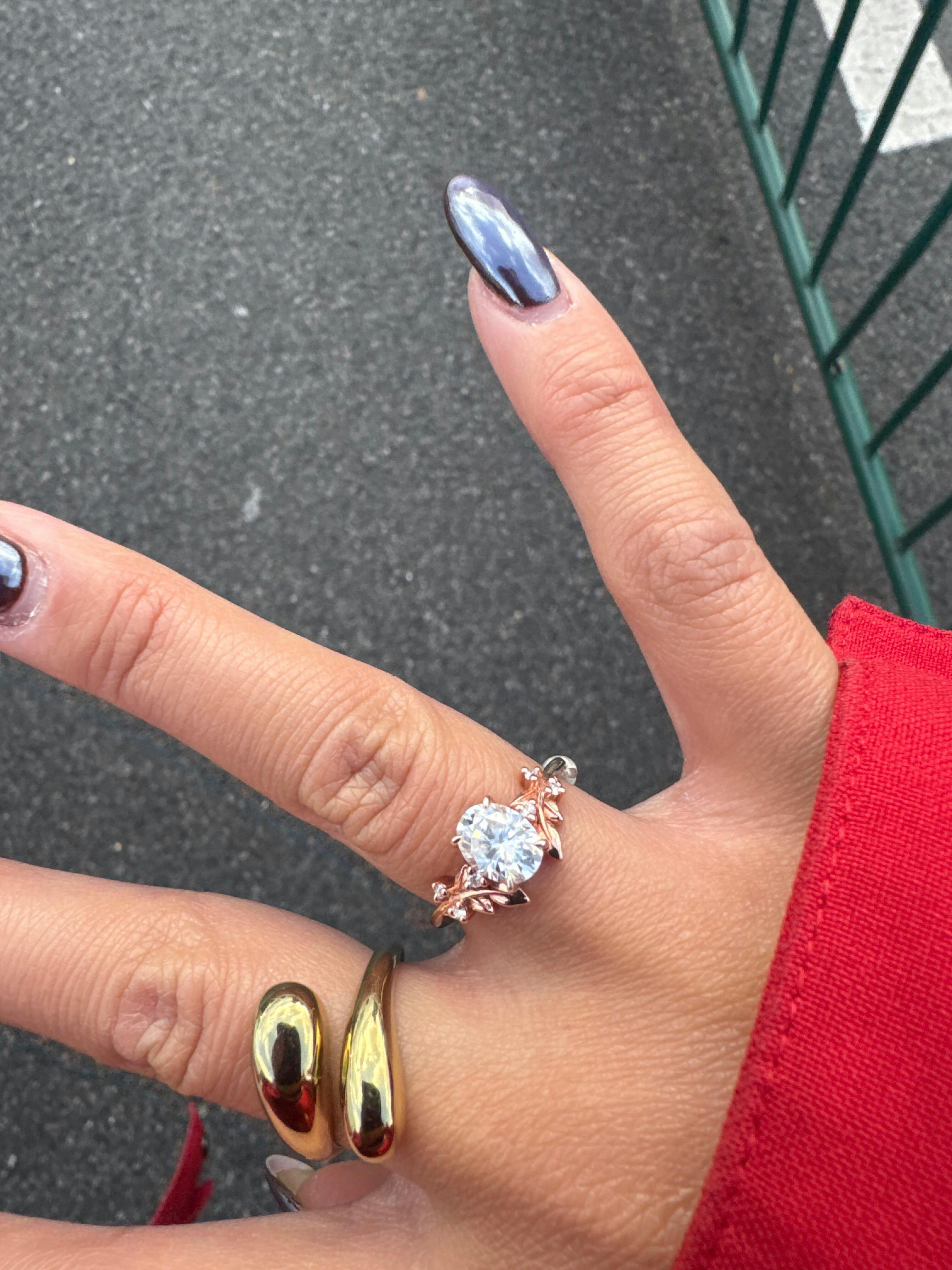
This most popular approach shares one key element—metal color, diamond shape, or era—without being identical.
- Pros: Balanced, curated look with personality.
- Consider: Requires light decision‑making to align the “shared element.”
Visual: Platinum solitaire paired with a platinum pavé band.
The Creative Contrast: The “Curated” Look
Intentionally mix metals, textures, or styles for a personalized stack that feels collected over time.
- Pros: High individuality; trend‑forward.
- Consider: Needs thoughtful balance to look intentional.

Pairing by Engagement Ring Style (Your “How‑To” Guide)
Start with your engagement ring’s architecture and silhouette—then choose a band that fits, flatters, and functions for your daily life.
Pairing with a Classic Solitaire
- The Opportunity: A solitaire is a blank canvas—almost anything works.
- Popular Options:
- Matching metal band (timeless minimalism)
- Diamond eternity band for continuous sparkle
- Twisted rope or knife‑edge band for subtle texture
- Pro Tip: Match the shank width for cohesion; a 1.6–2.2 mm band fits most classic solitaires.

Pairing with a Halo Ring
- The Challenge: Halo adds width and visual detail; bands should balance, not compete.
- Popular Options:
- Simple, plain band to let the halo shine
- Pavé band with melee-sized sized to match the halo’s stones for continuity
- Ensure a flush fit or consider a contoured band
- Pro Tip: Verify the head height—low halos often require a contour or notch to avoid a gap.

Pairing with a Three‑Stone Ring
- The Challenge: Proportions matter—match shank width and visual weight with the side stones.
- Popular Options:
- Straight band matched to the shank width
- Curved or contoured band to frame side stones without crowding
- Low‑profile eternity if the head allows space
- Pro Tip: Keep the band’s diamond size smaller than the side stones to maintain focal hierarchy.

Pairing with a Unique or Low‑Profile Ring
- The Challenge: East‑west heads, bezels, or ornate galleries often sit low and create a gap.
- Popular Options:
- Open‑cuff bands or chevron/V bands to nest around the head
- Custom‑made, contoured, or notched band
- Embrace a deliberate, non‑flush look for modern styling
- Pro Tip: Take your ring to the jeweler for a 3D scan or physical fitting when designing a custom band.

Related reads: See “Solving the Gap” below and the Ring Settings Guide.
Solving the #1 Pairing Problem: “The Gap”
Gaps happen when the engagement setting sits low or the center’s width blocks a straight band; solve with contouring, notching, or by styling the space intentionally.
Why gaps happen:
- Low‑set basket or bezel heads sit close to the finger.
- Wide centers or halos prevent a straight band from sitting flush.
- Cathedral shoulders or gallery details extend over the band area.
Solution 1: The Contour Band
A band with a gentle curve designed to hug your ring’s outline.
- Best For: Pear, oval, marquise, and halo.
- Fit Tip: Request a wax or CAD mockup to ensure the curve matches your ring precisely.

Solution 2: The Notched Band
A straight band with a small, precise cut‑out that your ring’s head nestles into.
- Best For: Round or cushion halos; low baskets with a defined footprint.
- Fit Tip: The notch should be invisible when worn; tolerance of ~0.1–0.2 mm is typical in fine work.

Solution 3: Embrace the Gap
Treat the gap as an intentional negative space—popular in minimalist and boho stacks.
- Best For: Low‑profile bezels, east‑west settings, and organic designs.
- Style Tip: Balance the spacing with a slim band (1.5–1.8 mm) so the gap reads as deliberate.

Pro Tips for a Perfect Pairing
Match shank geometry, mix metals with intention, plan for long‑term wear, and leave room for future bands.
Rule of Thumb: Match the Shank
- Match width: Keep band width within ±0.2–0.4 mm of your engagement shank for cohesion.
- Match profile: Flat vs. rounded vs. knife‑edge—keep geometry consistent for a seamless side view.
- Finish: Align polish level (high‑polish, satin, brushed) to unify the look.
Mixing Metals the Right Way
- Keep it to two metals for balance (e.g., platinum engagement ring + yellow‑gold band).
- Repeat the accent metal elsewhere (earrings or a second band) to make the mix feel intentional.
- Consider skin tone and wardrobe to choose your dominant metal.
Consider Long‑Term Wear
- Harder metals wear softer ones: Platinum can gradually abrade adjacent gold bands over the years.
- Eternity bands can rub prongs: A tall pavé eternity might contact a solitaire’s prongs—check clearance.
- Annual checkups: Have a jeweler inspect prongs, pavé beads, and band straightness yearly.
Think About Your Future Stack
- Leave space for an anniversary band or guard.
- Plan your order: engagement ring | wedding band | anniversary band often balances best.
- If adding later, echo one element (metal, melee size, or texture) for cohesion.
Related planning: Explore A Guide to Choosing Matching Wedding Rings and the wedding ring buying guide.
Pairing Your Rings: Frequently Asked Questions (FAQ)
Do my engagement ring and wedding band have to be the same metal?
Not at all. Mixed‑metal stacks are stylish and personal—just keep the mix intentional and balanced.
Should I buy my rings as a set?
Buying a bridal set guarantees a perfect match and a flush fit. Buying separately offers more personalization.
Can I wear my wedding band on its own?
Absolutely. If you’ll often wear it solo, choose a band that stands alone—eternity, engraved, or textured styles work well.
What is a wedding ring enhancer?
An enhancer (ring guard) is two bands joined at the bottom; your engagement ring slides between them to create a symmetrical, three‑ring look.
More style help: Find your vibe in the Ring Aesthetic guide and browse colorful options in buy birthstone engagement rings.
Find Your Perfect Match Today
Whether you prefer a perfect match or a curated contrast, the goal is a set you’ll love to look at every day. Start with your ring’s architecture, choose your pairing philosophy, and use contouring or notches when you need a flush fit.
- Explore Wedding Bands That Pair Beautifully
- Also see: shop Emerald engagement rings and coordinated looks in shop couple rings.


Lascia un commento